



















The Diploma Programme(DP)
In 1968, the International Baccalaureate Organization was created as a
non-profit educational foundation to educate and deliver a cohesive curriculum
recognized by tertiary institutions globally. The mission was to offer an
internationally recognized programme that prestigious universities would
recognize and welcome. From its modest beginnings, the number of IB World
Schools has grown to 3,848 with an added goal to make an IB education available
to students of all ages.
The International
Baccalaureate Organization aims to develop inquiring, knowledgeable and caring
young people who help to create a better and more peaceful world through
intercultural understanding, respect of diversity and global mindedness.
The IB Diploma Programme
(DP) is a demanding comprehensive two-year pre-university curriculum for
students aged 16 to 19, culminating in the IB examinations. With an
international IB Diploma, students will gain entry into the leading
universities around the world.
What Universities recognize the I.B. Diploma?
- There are currently 2545 universities from 75 countries that recognizes the
I.B. Diploma Programme.
For an ever-increasing
worldwide list, go to http://ibo.org/diploma/recognition/
You may download the IB Recognition Brochure by clicking on the image-link
below:
Curriculum
http://www.ibo.org/diploma/curriculum/index.cfm
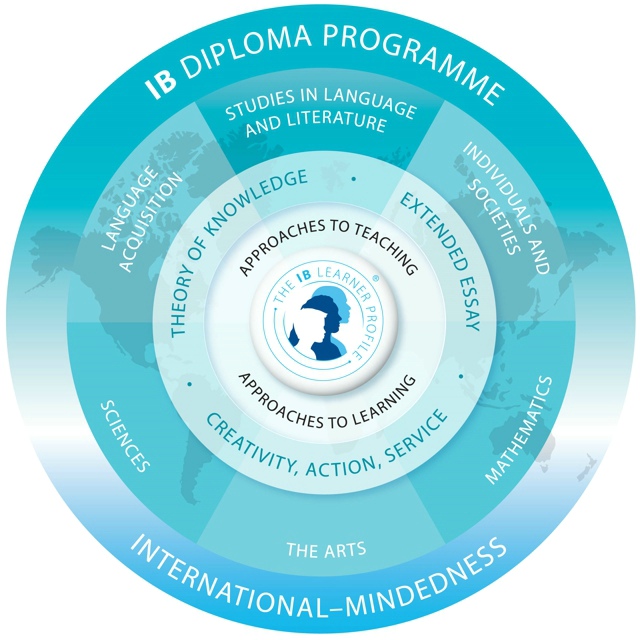
Our curriculum is made up of six subject groups with three components in the
core as shown in the hexagon.
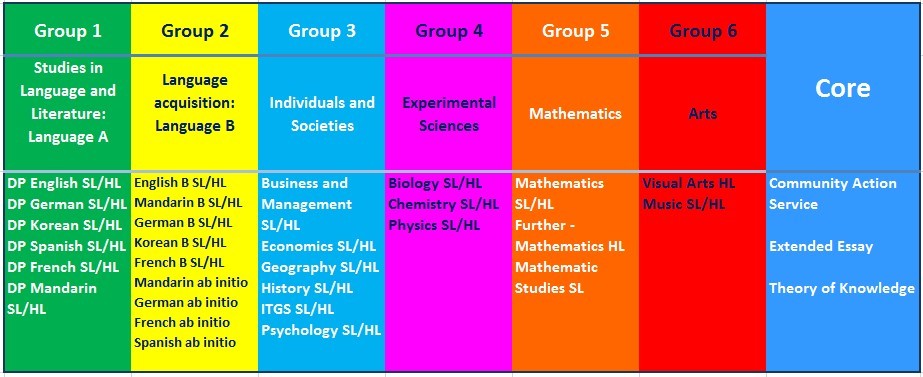
Changchun American
International School offers the following subjects. Students must study one
subject from each group and at least three and not more than four of the
subjects are taken in higher level (HL), 240 teaching hours; the others in
standard level (SL), 150 teaching hours.
TOK
The Theory of Knowledge course,
together with the Extended Essay are two additional academic requirements unique
to the DP.
If students do well enough on each they
can add valuable extra points to their score on their diploma.
The TOK is organized to be an
interdisciplinary program where students are helped to integrate what they are
learning in all their courses and challenged to act on it. TOK provides
the DP student the opportunity to see how seemingly distinct forms and
approaches to knowledge may share links or connections and have personal
relevance beyond the classroom.
TOK material is organized into two categories:
Ways of Knowing, which include the following 8 approaches: Emotion, Reason, Language, Sense Perception, Imagination, Intuition, Faith and Memory
Areas of Knowledge, which is also divided into 8 fields: Ethics, History, Natural Sciences, Human Sciences, Maths, Arts, Indigenous Knowledge Systems, and Religious Knowledge.
Students are expected to complete two
formal assignments:
A presentation on a knowledge issue arising from a real life situation
A formal essay, in the second year of the course, from a list of topics released annually by the IB exploring knowledge.